(Original Post Date: March 13, 2017. Updated 2025)
Faltering faith? Feed it!
The 1980s were challenging years for me. I began 1980 as a newlywed and 1990 as a mom to four kids. One of my challenges involved questions of faith. Born and raised in The Church of Jesus Christ of Latter-day Saints, I always had a rock-solid testimony of the gospel and of the Church. Still, like many American young women, I questioned some aspects of Church doctrine and culture. My older sister, Janet, asked similar questions. Listed below are issues Janet and I wrestled with:

- The LDS doctrine of plural marriage and its practice during the 19th and early 20th centuries.
- Women and priesthood authority.
- The Church administration and priesthood correlation program which had reduced the autonomy of women’s auxiliaries. (Correlation was instituted 20 years prior).
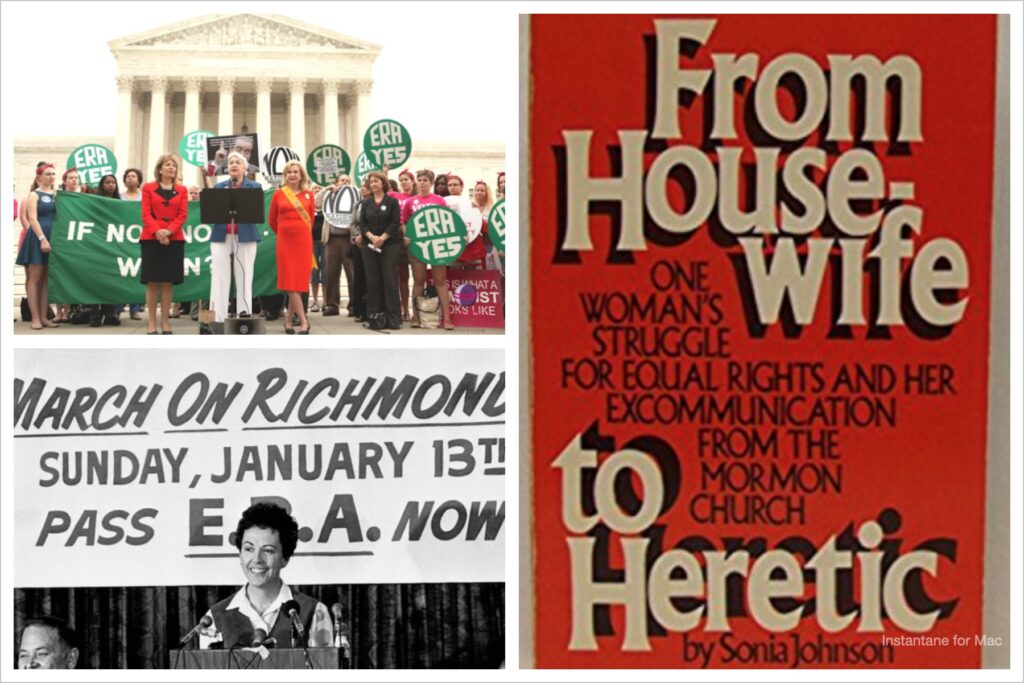
- The proposed Equal Rights Amendment to the United States Constitution (ERA) for women’s equality. (Ultimately, the amendment failed to pass, but many Church members were impacted by the political divisiveness.)
- LDS member Sonja Johnson, founder of “Mormons for ERA,” had recently published her book, From Housewife to Heretic, making her one of ERA’s national standard bearers. Excommunicated from the Church for apostasy, Johnson made national news while making the rounds in the national talk show circuit; she spoke against Church patriarchy, oppression of women, and its political stance against the ERA. Johnson was also a featured speaker at the 1980 National Democrat Party Convention.
- The recently published book, Mormon Enigma: Emma Hale Smith, Prophet’s Wife, Elect Lady, Polygamy’s Foe, written by LDS historians Linda K. Newell and Valeen Avery, gave fodder for Church critics. Their book portrayed a troubling and unflattering account of Joseph Smith’s character, his divine revelation and practice of plural marriage, and his troubled marriage to Emma. Openness to Church archives and historical accounts were much more limited before internet access, but that was also true for accessing secular information. The internet would not be invented for nearly 20 years; until then, research was difficult and results were often scanty and opaque. Janet and I knew several friends whose faith had been rattled after reading Mormon Enigma. Rightly or wrongly, we declined the read; why undermine our faith any further? (Years later, I read it with an indifferent shrug. If anything, I was reassured knowing that early Church leaders and members had human frailties and struggled with gospel doctrine—just like the rest of us.)
- Church leaders strongly discouraged mothers working outside the home. I was a stay-at-home mom for many years and have no regrets. I dud struggle in my conflicting desires regarding motherhood and my growing family with my desire to finish my bachelor’s degree, pursue a master’s degree, and begin a career in teaching.

(Above photos: Janet and I at Carthage Jail, Illinois in 2001. Rick, me, and our firstborn son in 1981.)
The purpose of my post is as follows:
- I discuss my own faith journey
- After having studied and worked in academia for 40 years, I discuss present-day ideologies rooted and propagated—especially in the humanities, social sciences, and ethnic studies for the past 30 years, and thus their influence on individual and collective faith in Christianity including the Latter-day Saint community
- I offer my own suggestions for shielding and building our individual faith
1. My Own Faith Journey
Janet and I grew up on the swells of second-wave feminism. Many young LDS women of our generation did not aspire to or desire a college education. During the 1970s, President Spencer W. Kimball helped to change this mindset by encouraging women to pursue higher education. Additionally, he instituted the policy allowing women to offer the opening and closing prayers in Sacrament meeting, and later established and presided over the first annual General Women’s Conference at the Temple Square tabernacle in October 1978. (I was a BYU student at the time and was able to attend.) One year, due to illness, President Kimball was unable to attend the conference so asked his wife, Camilla, to read his talk. Janet and I were impressed that his wife served as his substitute.
Still, the idea of LDS girls having career aspirations was not “on the radar.” The 1980s introduced a career woman momentum. The Church magazine, Ensign, featured articles about college educated women who chose to forego careers opting to apply their educational skills to full-time mothering. Please don’t misunderstand, I support and value the role of stay-at-home mothering; I was a stay-at-home mom. My point is to emphasize the mixed messages and emotions women experienced as societal and social changes offered new choices and increased opportunities.
Also at that time, LDS women entered into marriage (including Janet and I) at very young ages and were expected to bear children soon after marriage—lots of children. Our dad was a college instructor so instilled in us the value of higher education. My mother earned her college degree while pregnant with her fifth child during our teenage years. As a result, Janet and I obtained our college degrees (and later master’s degrees) after becoming wives and mothers.
Below, is the March 1983 Ensign magazine cover, and the first issue dedicated exclusively to Latter-day Saint women. Admittedly, Janet and I were a bit disappointed with the cover featuring a bread-baking mother wearing a frilly apron—in our view, underscoring the LDS stereotype.

As young mothers, we were pretty much anomalies among our peers because of our aspirations. We struggled under the pressure to fit into the traditional “Ultimate Mormon Woman” template. Twentieth century Latter-day Saint cultural norms—until the late 1980s—basically looked like this:
- Women were expected to get married, have lots of children, stay at home, cultivate homemaking skills and have great joy. (And, I’ll be the first to say, most children thrived in this environment and still do today.) “Working” mothers often felt judged by others in their “failure to follow the Prophet.” After having one child, I worked part-time for nearly a year helping to fund my husband’s college tuition. Two of my friends and even a bishop admonished me “to follow Church counsel” and “to put Church teachings first.” Later, as a mother to four children and pursuing my master’s degree, I felt again the judgmental sting from several LDS friends who criticized my “neglect” of my kids for “selfish desires.” Their pious criticism (cloaked in Church tradition) sounded like an excuse for their own choices. Surely, not all LDS women cast such harsh judgment. Yet, even today, women (inside and outside the Church) can put tremendous pressure on each other.
- Postponing having children after marriage and having “small families” were discouraged. (I remember one LDS friend told me, “Having five children is the bare minimum … ” I had four kids while pursuing my master’s degree, and she was one of my critics.)
- Gender roles were much more pronounced. Six years before I was married, this 1973 Ensign article counseled husbands and wives. Here’s a few specifics listed for husbands: “Be man enough to change the baby’s diapers … and occasionally bathe the children.” Some specifics listed for wives: “Prepare good meals for him, especially when he is late for dinner. Take telephone messages for him carefully and see that he gets them. Free the telephone when he needs it.” Here’s the link: https://www.lds.org/ensign/1973/06/for-husbands-and-helpmeets?lang=eng. Again, I don’t suggest this advice as inherently wrong; it exhibits the cultural LDS expectations at that time.
Like I said, Janet and I grappled under these pressures in striving to “become.” Still … neither of us wanted to give birth to congregations of children. (Janet had three, I had four.) We both wanted careers in education; Janet became a a middle-school teacher, and I eventually taught college. Unlike me, Janet enjoyed (and is very proficient) at baking. Our homes were very clean and orderly, and we were both good cooks. (I didn’t enjoy cooking but knew the importance of nutritious meals and family dinnertime.) Neither of us enjoyed sewing (Janet enjoys needlework) though we had sewn a lot of our own clothes in high school. Early in my marriage, I did some sewing until it was no longer cost-effective. Still, I felt little to no joy in sewing. Or baking. Or crafting. Or canning. Or quilting.

(1987: My daughter’s Blessing Day)
By our mid 30s, Janet and I had grown much more confident in relying upon the Spirit in prayerful decision-making. This reliance helped us to separate Church culture from Church doctrine with the assurance of God’s will for us as individuals. Most importantly, we learned to care more about the Lord’s opinion of us than the opinions of others. We have spent our lives as devoted wives, mothers, grandmothers, and active Church members despite our earlier frustrations, doubts, and fears. One earlier fear that had plagued us the most was the doctrine of plural marriage. No matter how much we talked and tried to console each other, Janet and I couldn’t reconcile what we called “the crazy aunt in the basement” doctrine. (I revisit this topic later in this post.)
Do you, dear readers, have similar feelings? Do you struggle with your faith? Do you struggle to “fit in?” Do you feel insecure or fearful of various aspects of LDS culture, Church policy, doctrine, or Church leaders? Are you rattled by competing voices within and without the Church? Are you troubled by Church history? Do you feel like Church culture (and Christianity in general) is becoming more divisive and fractious? Do you feel pressure to “pick a side?” (In the United States and other Western countries, I suspect that many Church members the growing political and cultural divide regarding the roots and fundamental principles of Western civilizations. The good news: our faith in Jesus Christ can supersede all doubts, fears, and resentments.

2. As a principle, our faith will always be tried. Presently, in the United States, Canada, the United Kingdom, and Western and Northern Europe, the most obvious or vocalized “trial of faith” seems to stem from differing philosophies regarding Western civilization, its ethos, and its legitimacy on the global stage.
How did we get to this point? What, why, and where do these divisions come from? And in what ways can present-day philosophies affect our own faith in Jesus Christ, in The Church of Jesus Christ of Latter-day Saints, the Prophet, and apostles? In the rest of this post, I humbly try to partially address these potential influences to our personal and collective faith. Please know, I’m not here to promote or denigrate any particular political, social, or cultural worldview. And I don’t claim to have all the answers or an all-knowing wisdom. Like anyone else, though, my background and personal experiences inevitably shapes how I see the world. Regardless of political and social views, I truly admire defenders, advocates, prosecutors—anyone who truly has the courage of his or her convictions.
As mentioned the the subtitle, today’s fiery political and cultural divisions within Western countries share a common thread: the questioning and deconstruction of Western civilization and its legitimacy in a global world. For the past 25 years, the West’s guilt over its history, prosperity, and world domination has undermined its self-confidence regarding its tenets, institutions, and global influence. Similarly, these same philosophical fractures are happening in Christian denominations who regard Western institutions and tenets based in Greek and Roman philosophy and Judeo-Christian ethos as oppressive, bigoted, and racist. For instance, England’s Anglican church and America’s United Methodist church (among others) grapple—and in some aspects have conceded—their moral authority to postmodern moral and cultural relativism in the name of love and inclusivity. My move to Utah several years ago has given me a perch with a clearer view of the similar fractious developments within our Latter-day Saint community. Those who have left or are leaving the LDS Church have formed their own support communities while publicly sharing their reasons for leaving: a faltering or lost faith in Church leaders, Church history, Church doctrine, and policies including “The Proclamation of the Family and the patriarchal order. Thus, their moral reasoning seems to echo the above listed ideological discontent of the Western civilization, American institutions, and their basic desire to embrace ideological principles and moral imperatives based in Critical Theory including its subsets of deconstruction, intersectionality, equal representation, inclusivity and diversity, equity, and so forth under the banner of “kindness and compassion.”
Please don’t misunderstand me. I believe critical theories and their mandates have merit and are worth debating. I support those who question Western tenets and institutions, Christianity including the LDS church. Those who embrace critical theories and their moral imperatives have legitimate feelings and ideas that are worth examining and debating in the public square for purposes of public policymaking. I believe that all ideas should not be censored but rather welcomed in the public sphere of examination and discussion. And, there’s no doubt their influence has had a massive global impact.
Around 2010, these organizational structures had become highly organized and mainstreamed into American and Western institutions and politics in what is now called “Diversity, Equity, & Inclusion” or DEI (formerly called Diversity, Equality, and Inclusion). They are the analytical and moral lens in examining and exposing what they believe to be oppressive economic power structures and their oppression of marginalized peoples, and in deconstructing and dismantling (or greatly diminishing) the global power and influence of Western civilization and Western countries including their global economic power, their patriarchal institutions, societies, and their “white supremacist” ethos based in Greek, Roman and Judeo-Christian tenets and traditions.
As we know, critical theories, their ethical principles and practices (including political, economic, social, and cultural practices) have had massive a global impact in transforming American and other Western societies through multiculturalism and mass migration.
Such transformation is shaking the institutional foundations of Western civilization. Critical theories and their activism, advocacy groups, and politics support open borders and abolishing strict state-enforced citizenship restrictions. They believe that the restricted movement of marginalized “global citizens” is a tool that privileges Whites and the wealthy. National boundaries and national sovereignties are viewed as mechanisms of systemic inequality, colonialism, and global capitalism.
As an aside, I gave a Sacrament meeting talk last month about these ideas and their societal influences. Afterward, three teenage girls approached me and said: “Thank you for talking about these things. We never hear anything about it … not from our Young Women’s leaders, in Young Women’s lessons, or in Sunday School. Why not? How come nobody talks about this?” Hence, the need for me to write about this stuff!
3. So, what are critical theories, where did they originate, and how did they become mainstream?
I don’t claim to be an expert or a historian, however, I was schooled in critical theories as a student, graduate student, and trained as a college instructor using critical theories. To be able to discuss today’s cultural and political divide, we need some sort of basic knowledge. I humbly offer mine.
As stated before, Western countries like the United Kingdom, Ireland, Western and Southern Europe, Northern Europe (or the Nordic countries), etc., were heavily influenced by Judeo-Christian principles. For instance, Greece’s Christian roots were planted by the Apostle Paul after Christ’s death. For over a thousand years, European civilization and its subsequent offshoots (and later in America’s founding) were fundamentally built upon the principles, laws, and moral frameworks of the Christianity; a historical period often referred to as “Christendom.” According to the Interdisciplinary Encyclopedia, there are three “Key Pillars of Christian Influence”:
- Law and Governance: Early Western legal systems drew heavily from biblical principles. Concepts like universal natural law, the inherent dignity of the individual, and basic human rights reflect the foundational belief that humans are created in the image of God.
- Institutional Development: Many of society’s core institutions originated from the Church. The first hospitals, universities, and charitable organizations were established under Christian influence.
- Calendar and Time: The Western calendar itself is structured around the birth of Jesus Christ, utilizing the Anno Domini (A.D.) system to mark historical years.
In my lifetime, I’ve watched Christianity’s (and eventually Western civilization’s) diminishing influence and its contribution to societal cohesiveness in Western societies. My brief timeline is way overly simplistic, I know:
- The 1950s and 60s experienced rise of postmodernism and secularism in higher education and Western societies
- The 1980s and 1990s experienced the expansion and integration of Critical Theory in Western universities
- During the 2000s until today, critical theories, their globalist approach, their edicts and practices became the academic framework in Western universities while seeping and becoming mainstream in Western societies, culture, and public policymaking.
Origins of critical theories
Postmodernism. Dr. James Lindsay and Dr. Helen Pluckrose, scholars of postmodernism and critical theories, offer this context:
“[Postmodernism] primarily emerged between 1950 and 1970 … which featured consistent underlying themes that have come to drive contemporary activism, shape educational theory and practice, and inform our current national conversations.
These include skepticism about objective reality, it proposed moral and cultural relativism, the perception of language as the constructor of knowledge, the ‘making’ of the individual, and the role played by power in all of these. Postmodern ideals have gained cultural popularity and legitimacy through the academy [universities and colleges], creating a conceptual schism that underlies many of our current social, cultural, and political divisions” (Critical Cynical Theories. 2020. Introduction).
[Postmodernists believe] in a radical skepticism about whether objective knowledge or truth is obtainable and a commitment to cultural constructivism (which holds that societies construct reality with the way they understand it and talk about it) … society is formed of systems of power and hierarchies which decide what can be known and how.
Postmodernism’s four major themes are:
- The blurring of boundaries
- The power of language
- Cultural relativism
- The loss of the individual and the universal” (p. 31).
As a child during the 1960s, I remember the “hippies,” “flower children,” and the “free love” movements all personifying postmodernism. Since then, empirical evidence has often become suspect as are all traditonal and culturally dominant ideas including science, reason, and universal liberalism. Such Enlightenment values are often considered totalizing and oppressive with a moral necessity to deconstruct and dismantle them while putting more emphasis and credibility on the lived experiences, narratives, and beliefs of marginalized groups—all of which are equally “true.” Therefore, to reverse an oppressive, unjust, and entirely arbitrary social construction of reality, morality and knowledge stemming from Western ideals and institutions—marginalized narratives must now be privileged over Enlightenment values and narratives.
Critical Theory is one of the branches of postmodern thought and, as stated earlier, was seeded, incubated, and propagated in Western universities. By the late 1980s, postmodernism eventually seeded and harvested critical theories including critical race theory, queer and gender theory, feminist studies, intersectionality, post colonial theory, and deconstructionism. implementing them in course curricula within the social sciences, humanities, and ethnic studies.
Critical theories had become academia’s ethos and structural framework including course objectives, curricula, and classroom implementation beginning in the social sciences, humanities, and ethnic studies, and eventually spreading into the hard sciences, and in law, journalism, and medical schools.
Around 2010, critical theories had spread from universities into the cultural and political mainstreams in Western societies. Therefore, in my humble opinion based on my own lived experience as a student and college instructor in academia, some of our divisions within the LDS community could be viewed as a microcosm in reflecting similar cultural, moral, and political shifts in American and Western societies.
So, what are critical theories?
Critical theory originates from postmodernism. Many of the ideas perpetuated by today’s scholars and leftist progressives regarding social justice, equity, and transformative change stem from postmodernism and critical theory, and are a variation of socialism. In short, critical theories are social, philosophical, and political analytical tools for framing, critiquing, and challenging systemic power relations in Western societies (especially America’s founding and institutions) in what they see as inherently patriarchal, racist, inequitable power structures. Lindsay and Pluckrose provide this definition:
“A critical theory is chiefly concerned with revealing hidden biases and under-examined assumptions, usually by pointing out what have been termed ‘problematics’ which are ways in which society and the systems that it operates upon are going wrong” (Critical/Cynical Theories, 2020, Introduction).
They’re focus is on power structures … they interpret the world through a lens that detects power dynamics in every interaction, utterance, and cultural artifact … This is a worldview that centers social and cultural social and cultural grievances … with addressing and redressing social inequalities, particularly where it comes to issues of class, race, gender, sex, and sexuality, particularly when these go beyond the reach of legal justice” (p. 89).
Woke, wokeism, wokeists, and critical theorists. “Woke” is a 20th century word that gained academic prominence in the 1990s and is basically a nickname for Critical Theory. Dr. James Lindsay, a scholar and author, offers this definition:
“In brief, ‘woke’ means having awakened to having a particular type of ‘critical consciousness,’ as these are understood within Critical Social Justice [Theory]. To first approximation, being woke means viewing society through various critical lenses, as defined by various critical theories bent in service of an ideology… That is, being woke means having taken on the worldview of Critical Social Justice [Theory] which sees the world in terms of unjust power dynamics and the need to dismantle problematic systems. That is, it means having adopted [Critical]Theory and the worldview it conceptualizes.
Under ‘wokeness,’ this awakened consciousness is set particularly with regard to issues of identity, like race, sex, sexuality, and others. The terminology derives from the idea of having been awakened (or, ‘woke up’) to an awareness of the allegedly systemic nature of racism, sexism, and other oppressive power dynamics and the true nature of privilege, domination, and marginalization in society and understanding the role in dominant discourses in producing and maintaining these structural forces” (“New Discourses.” (n.d.). Commentary.).
Critical race theory.
2. Guard personal faith when analyzing or embracing secular philosophies: watch for extremes and irrationalities in their reasoning, moral imperatives, political drivers, and/or their calls for unhealthy and narcissistic personal pride.
So, how do we get from doubt to faith to peace? How do we attain and sustain our faith and peace? For me, effortful and consistent humility and faith in Jesus Christ has been the only answer. The prophet Alma was right; faith doesn’t mean a “perfect knowledge” or understanding (Alma 32). Surely, Christ knows and understands everything perfectly. Exercising faith in Him, I can weather stormy ideological and cultural contentions and their deceptions. Attaining, sustaining, and increasing faith is a bumpy ride. Humility, spiritual and emotional transcendence are difficult task masters.
In part, we navigate our personal faith journey by how we uniquely see the world. Because our vision is often clouded by our limited perceptions, our faith is limited by ambiguity. When we regularly remind ourselves of these limitations, embracing this ambiguity helps keeps our faith alive and growing. The principle of faith is, by its very nature, is ambiguous. Our own ignorance, weakness, and prejudice taint our lens and distorts our judgment. This principles frustrates me because I like certainty, I like specifics. I think most of us do. The process of seeding, growing, sustaining, and increasing faith starts out simple enough, but as our faith is tested and tried, our efforts to grow and sustain it can be exhausting. Karl Marx claimed religion to be “the opiate of the masses.” On the contrary, religious faith requires enormous amounts of self-discipline, humility, determination, and self-examination. Again, a faith journey is not for the faint of heart.
The saying, “Pride goeth before the fall,” is true. Unless I work to stay humble in all facets of my life, I can reason myself right out of my faith. My shaky faith emerges when I feel frustrated by personal weakness, “unanswered” prayers, and vulnerability in efforts to surpass weakness and sin.
After years of studying the Book of Mormon, I’ve decided that Laman and Lemuel (from an intellectual standpoint) were sometimes the reasonable ones in Lehi’s family. They had ample reasons for complaining all the time: they had left their home, friends, wealth, and position in Jerusalem to wander for eight years in the desert. Furthermore, their resentment was rooted in Lehi’s reason for the family’s departure when he claimed to have “dreamed a dream one afternoon while laying on [his] bed.” No matter one’s faith, this kind of upheaval would upset anybody. From time to time, Laman and Lemuel were forcibly humbled, but their humility and faith evaporated when faced with obstacles; their reasoning always obliterated their faith. Conversely, Nephi suffered the same hardships and uncertainties yet still had the ability to bear these challenges with grace and patience. Why? Because Nephi exercised consistent faith and humility enabling him to obtain his own sustaining spiritual witness. Rewarding Nephi’s faith, the Lord granted him the same vision Lehi had seen. The Spirit continually sustained Nephi’s faith, softening his heart while enduring great suffering and seemingly insurmountable obstacles. Nephi’s words reflect humility and faith:
“We must lay aside our sins, and not hang down our heads, for we are not cast off. Nevertheless, we have been driven out of the land of our inheritance, but we have been led to a better land, for the Lord … Wherefore, my beloved brethren, reconcile yourselves to the will of God, and not to the will of the devil and the flesh; and remember, after ye are reconciled unto God, that it is only in and through his grace that ye are saved” (2nd Nephi 10: 20-22).

“Father Lehi’s Dream”
Like Nephi, Christ helps us access a better land (or environment)—not just a temporal land but a spiritually, emotionally, and intellectually better land while we trudge through our fears, doubts, and anxieties along the way.
Feisty Jacob who “wrestled with an angel” trying to obtain the Lord’s blessing also inspires me. Genesis, Chapter 32 details Jacob’s experience the night before he met with his estranged brother, Esau. Although the Old Testament is not clear about what exactly transpired, we do know that Jacob wrestled all night with the angel. “I will not let thee go, except thou bless me!” he tells the angel (verse 26). Breaking his thigh bone during the struggle, Jacob eventually got the Lord’s blessing. I like the word “wrestle.” I think God likes a good wrestle. When I wrestle hard enough, the Lord comes through.

“Jacob Wrestling With an Angel” by Lelore
(2 Nephi 12: 8-9).
Their land is full of idols; they worship the work of their own hands, that which their own fingers have made. And the mean man boweth not down, and the great man humbleth himself not” (2 Nephi 12:8-9).
How might a person’s individual faith in Jesus Christ, in prophets and apostles, one’s membership in the LDS Church be potentially affected (or not affected) by ideological theories and their practices in our secular society … which in turn may influence our Latter-day Saint community?
Rightly or wrongly, critical theories’ structural identity markers and belief systems have been integrated into various Christian denominations.
Mainline Protestant Denominations
These denominations have faced years of internal struggle over progressive social ethics, changes to biblical language, and inclusion:
- The United Methodist Church (UMC): Fractured heavily over theological liberalism and the inclusion of LGBTQ+ members and clergy.
- The Presbyterian Church (USA) & The Episcopal Church: Have broadly adopted more progressive stances on social justice, marriage equality, and inclusive language. [1]
Not long ago, I was watching a CBN (Christian Broadcasting Network) program that regularly featured a group of Christian women leaders discuss anti-racist ideals and practices within Christian churches. For years, their faith had been inspired me. A Latina (or Latinx) leader now questioned the Bible’s legitimacy because it had been written and translated by white men; thus, the interpretation of Christ’s teachings were skewed and racist. I was taken aback and wondered how, going forward, these leaders would navigate Christian doctrine and principles without or with “tainted” Biblical legitimacy. Critical theories run deep and with a wide swath!
In this present-day battle over moral ethos and credibility, a group of non-denominational pastors have formed a website called TheosU that offers their own “line of defense” in the form of online courses for “confused” Christians:
“Woke movement leaders have successfully paired Christian theology with justice-based liberation theology. The orthodox gospel has transitioned into a social gospel, which is more political than faith-based. Woke theology seeks to replace key elements of Church doctrine and shift social thinking from addressing sin to addressing social change.
In a negative sense, woke theology asserts that Christians should recognize that severe societal injustices exist. Further, Christians are to realize that racial privilege contributes to these inequities and negatively impacts the environment, economy, educational opportunities, and social harmony. Woke theology views the Church as largely being responsible for these inequities.
Woke theology advocates for a new matrix to assess past and present laws and mores. Values and customs associated with America’s Christian heritage or the beliefs of the historic Christian Church are likely to be viewed as leading facilitators of injustice and, therefore, are enemies of the state.
Woke theology has impacted the church in three primary ways: 1) woke initiatives are emphasized over theological directives 2) supporting woke objectives is increasingly viewed as the means to save the earth and humanity and 3) woke theology compromises orthodox teaching” (https://www.theosu.ca/course/woke-theology).
- Analyzing brands of activism and their methods to gain compliance
Not only do we need to analyze propositions for public policy, but any form of advocacy and activism should be subjected to public inspection. What are their methods of persuasion? their expectations of individuals and the public? What are potential outcomes if their opinions are codified into law? What is their use of language, definitions, and contextual meanings, and how do they use them? And what are their strategies and methods to gain and/or to force the public to comply with their edicts?
We can more effectively analyze ideological principles, methods, and policies by asking ourselves the following questions:
a. Do advocates seek control and domination? Who do they want to dominate and why? Are they seeking personal power, status, and wealth?
What methods do their advocates use? Do they use fear, shame, or guilt to get people to comply?
Do they rely on suppression of information or censorship?
What are their moral codes, rules of conduct, and edicts?
How do they enforce their moral code? What are their punishments for those who don’t comply?
b. Look for historical patterns and examples of “noble” or utopian ideas that have resulted in authoritarianism, tyranny, and totalitarianism. Do present-day activists promote their own brands of authoritarianism, tyranny, and totalitarianism? Do they project and accuse their opponents of authoritarianism and tyranny while they themselves are guilty of using these same methods?
Surely, any belief system, philosophy, and ideology—no matter how righteous and noble its intentions becomes harmful and destructive when taken to extremes.
History repeats itself, and we need only look to 20th century atrocities to find examples of failed utopias in the form of authoritarian rulers and totalitarian governments. Their attempts to create and sustain egalitarian societies have thus far resulted in mass starvation, ethnic cleansing, political imprisonment and torture, religious persecution, forced collectivization, forced labor camps, and other ravages. Personally, until or unless my mind is changed, and despite its imperfections, I believe that Western Civilization institutions have been more successful in ultimately producing, evolving, and expanding liberties and freedoms than any other ruling authority or government in world history.
c. Search for dogmatism or a tendency to push principles as incontrovertibly true without considering any evidence or the opinions of others.
One of America’s founding principles differentiates between a democratic government “by the people and for the people,” versus a theocratic government that installs leaders who are members of a religious clergy where the state’s legal system is based on religious law. While teaching critical thinking, I taught my students (many of whom never participated in organized religion) to analyze, discern, and recognize ideologies, belief systems, and their moral imperatives—those which claim to be emancipating, unfettered, and liberating—but are still closely structured like an organized religion or a closed society.
d. Look at the activists’ methods in getting people to comply. Do their methods include secrecy and subterfuge? For example, do they use anonymous “tattle-tale” committees to report incorrect language and behavior to higher authorities?
Do their methods use fear? Do you feel intimated if you don’t comply? Do the leaders and followers use group pressure in attempts to make you feel guilty or ashamed if you don’t conform or if you make a mistake? Do you feel anxious when trying to follow their rules or moral codes? Do you feel pressure to “voluntarily” comply, conform, or obey their rules? Are you afraid of what they will say or do if you question or don’t follow their rules or moral code? Are you afraid to associate with dissenters or people who question the rules or the moral code? In other words, do you feel judged by simply associating with “dissenters?” Do you stay silent to avoid being lectured, criticized, singled out, or punished? Do you “go along to get along?” Are you afraid to state your personal opinions? if so, you are under authoritarian rule.
e. Look at the punishments given to those who question or fail to comply.
In one of his letters to the Corinthians, the Apostle Paul writes, “For now we see through a glass, darkly; but then face to face: now I know in part; but then shall I know even as also I am known” (1 Corinthians, 13:12). I have watched so many impressionable students peer through the lenses of critical and intersectionality theories; and that’s a good thing. However, when students are not exposed to differing philosophies and contexts, their ability to think critically, to reason, and to effectively communicate is hampered and distorted. Instead, a heavy reliance on feelings, emotion, combative language, together with a pressure to conform, can encourage zealotry in students while ushering in new forms of bigotry, hatred, and/or oppression. I see it now as I watch Western societies around the globe descend into division, chaos, hatred, and anarchy because too many peer through an increasingly dark lens.
I believe we can increase or decrease personal faith in accordance to the lens we choose to “see through a glass, darkly.”
If we seek to stabilize or increase personal faith as it pertains to Latter-day Saint doctrine, history, leadership, or fellow Saints, we might consider a careful inventory of our own sins and weaknesses. It’s so easy to focus on the sins and weaknesses of others—especially those with whom we disagree—while diminishing or personal weakness and bias. Even though I constantly fail in trying to fully live gospel principles, I do know that pure love—not manipulative or compulsory—love, compassion, and kindness are not selective or conditional to certain groups.
In October, 2022, Elder Ahmad Corbitt, who was serving in the Young Men’s General Presidency at the time, addressed activism against the Church in a talk to military chaplains:

Brother Ahmad S Corbitt: How activism against the Church can blind, mislead ‘valiant’ souls
www.youtube.comBrother Ahmad S. Corbitt, first counselor in the Young Men general presidency, spoke to Church-endorsed chaplains in the Conference Center Theater on Oct. 4,…
- Intellectual ability can increase personal arrogance and pride
I believe arrogance and pride can be the twin blights within academia and in today’s society. These blights can easily affect graduates of higher education. I have listened to brilliant scholars and graduate students who, because they have acquired a significant amount of secular knowledge (though often insular knowledge) believe their judgment and knowledge as beyond question; they personify a type of moral superiority.
Canadian professor, author, and speaker, Dr. Jordan B. Peterson, frequently writes and produces podcasts about “the arrogance of the intellect.” See https://youtu.be/nNpU1LOFDok?feature=shared. Dr. Peterson claims that knowledge and wisdom are not the same. I agree; I’ve listened to very knowledgeable professors who seem to be lacking in some wisdom—or even a bit of common sense. I’ve also listened to people who have little to no formal education who were full of wisdom. Surely, human nature makes all of us vulnerable to variations of pride and arrogance. These twin human frailties distort reality along with our perceptions of self, others, and truths.
A couple of years ago, a young, very intelligent, and highly educated friend of mine stated incredulously, “I can’t believe that you, Julie, would put your trust in the LDS prophet and apostles before your own judgment.” I responded, “That’s not what I believe. I put my full faith in Jesus Christ. When I humbly follow Christ, He leads me to righteous conclusions that ultimately align with the Prophet. This process increases my faith in the Latter-day Saint Restoration and its gospel teachings.” There can be a fine line between our expertise or intellectual prowess and our humble faith.
Truly, a focus on Jesus Christ combined with personal humility helps to alleviate the poison of self-centeredness and pride.

“Divine Companion” by Youngsung Kim
3. Feeding Personal Humility Increases Faith
I cannot emphasize this principle enough. Alma taught that faith comes from submission to the word of God. In the Book of Mormon Alma observed the Zoramites and how “they were cast out of the synagogues because of the courseness of their apparel…” (Alma: 32). Alma was hopeful that the Zoramites’ subsequent humility had caused a change of heart in allowing the seeds of faith to grow within them. Elaine Shaw Sorenson in her article, “The Seeds of Faith,” gives us significant insight:
“Alma’s lesson has meaning today. Latter-day Saints seem naturally inclined to focus upon their works. This propensity to rely so heavily on works that document obedience seems to be an outgrowth of our present technological, behavioristic society, which places to much emphasis on observable achievement. Increasingly encumbering and complex, family, career, and even Church activities can disperse attentions toward multiple distractions among tasks and programs. Illusionary time and goal management techniques, if not grounded in basic Christian nature, can further contribute to task-based rituals and repetitions in life.
By extending ourselves laterally outward in noisy worldly ways, we risk becoming swallowed up int he proud illusion of progress (Alma 31:27), when what we need is to extend quietly inward toward humility and upward toward God. As with the apostate Zoramites who laced the essential humility that leads to faith, the achievements and prosperity that embellish our lives become meaningless trappings of mortality with no eternal significance without faith. Doing home teaching, earning a scout merit badge, or doing other assigned acts of service can become little more than offerings on the Rameuptom (Alma 31:21) if our hearts are not earnest and our daily nature not Christian” (BYU Religious Studies Center, 1992).
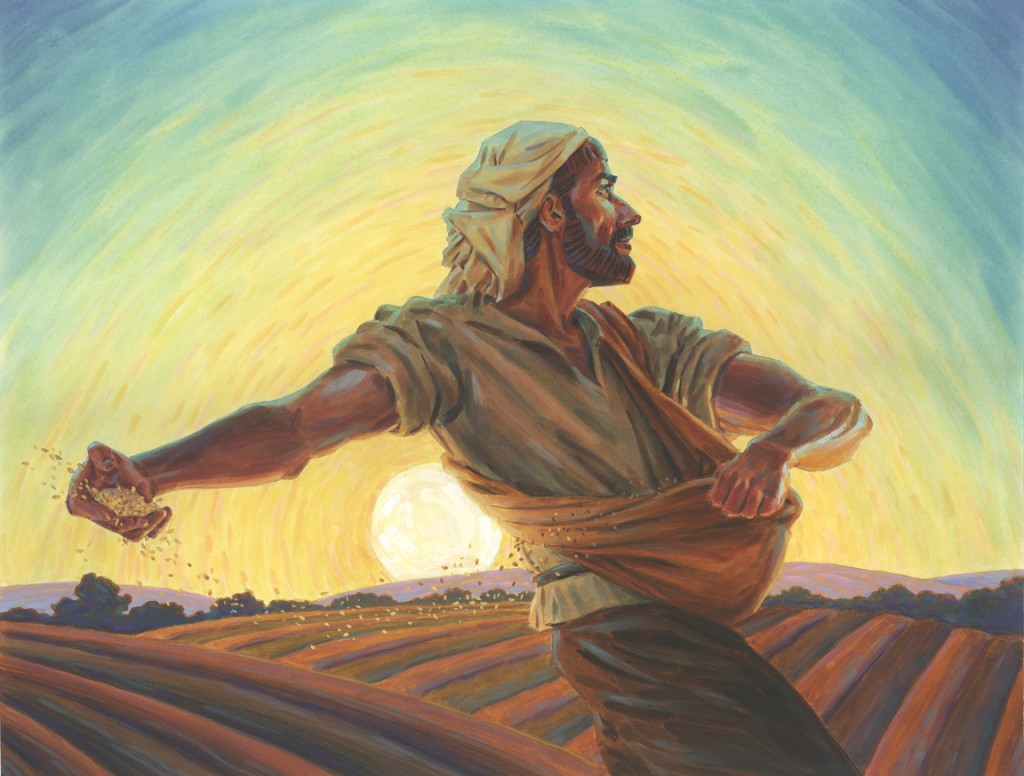
“The Sower”
Genuine humility rather than compelled humility acts as a forcefield against fiery darts of contention, agitation, and self-doubt. These brands of arrogance and pride are the antithesis of humility because they claim little to no need of Christ (or in any kind of higher power). Like some secularists, religious agitators might also claim having superior knowledge thus knowing what’s best for all of us. In any case, I prefer to invest my faith in Jesus Christ and also in the Prophet rather than in fellow Church members.
At the beginning of this post, I talked about my concerns regarding the LDS doctrine of plural marriage. This doctrine fueled my feelings of resentment, dread, and indignation. For years, I pushed away these feelings and refused to think about polygamy. As my personal relationship with God increased, I decided to “confront” God about (in my view) this “reprehensible” doctrine. His response to me was swift and sure. I received a very clear and strong impression: My questions and concerns would not be answered until I sincerely humbled myself. This meant clearing my mind and heart (at least temporarily) of resentment and prideful negativity. I will admit; it took some mental exertion and sustained effort on my part to get there. That weekend, I planned to watch semi-annual LDS general conference knowing that the Spirit would soften my heart and open my mind. After Sunday’s concluding session, I drove to the church parking lot, sat in my car, and prayed for some answers. I did not receive detailed information, but a loving God provided me with some insights regarding plural marriage. If anything, I came away with more questions than answers. Nevertheless, I felt heard, validated, and reassured by my Heavenly Father. Even more, I felt respected. I felt His love. I felt peace and joy. And that’s all that mattered to me. I drove home with a satisfied and thankful heart.
Whenever doubts or questions inflict my soul, I work to humble my heart and take my concerns to God. His counsel, His grace, and His love are infinitely more cathartic and therapeutic than anything or anyone else on earth. Our inner peace that comes from God and our Savior is able to transcend any doubt, anxiety, fear, or even anger we may have in regard to our Church leaders, fellow members, doctrine, and/or local Church culture.
4. Becoming Comfortable With Uncertainty
Faith is the antithesis of certainty. I’m still having to learn to feel comfortable with unanswered questions. I learning to suspend judgment of anyone or anything before genuinely seeking answers and insight through the Spirit. Additionally, the best way (for me) to overcome doubt is to water the righteous seeds of faith and nourish them through utilizing the spiritual gifts enumerated in the New Testament, the Book of Mormon, and the Doctrine and Covenants. Intellectual study of the gospel surely has its own advantages. I spend significant amounts of time in intellectual study. Yet, ultimately, I believe we won’t find lasting answers or peace to our questions using this method; we find answers and peace in seeking the Savior. While seeking Him, we can ask for ever-increasing faith. Having faith in Christ is specifically listed as a spiritual gift in the scriptures. We can pray for this specific gift to increase our faith and, in turn, increase our peace.

Rabbi Evan Moffic believes uncertainty possesses its own kind of beauty:
Faith is not about answers. We err if we think faith solves our uncertainty. Authentic faith is not about easy answers. Rather, it is about finding the courage and wisdom to live with uncertainty. Faith can help turn uncertainties into blessings. In fact, uncertainty can ultimately sustain and make our faith even stronger. I first recognized this truth during a visit to Venice. The city has magnificent churches. Yet, these churches are built on lagoons. The soil is watery and muddy. How can such shaky ground hold up such extraordinary structures?
The tour guide explained the way it works. The churches are built on thousands of wooden poles that move with the tide. Those movements counter-balance one another, keeping the structure high and intact. The very shakiness of the structure keeps it standing. The same is true with faith. The uncertainties we face sustain us. They bring us closer to one another. They bring us closer to God. It is through the uncertainties, the challenges, the crises—what the Psalmist calls the “valley of the shadow”—that we see God is truly with us.
Uncertainties also sharpen our vision. They help us refine and grow in faith, separating the wheat from the chaff, the sacred from the mundane. It is not certainty that leads to faith. It is the courage to live with uncertainty. An 18th century rabbi named Nachman of Breslov said, ‘the whole world is a narrow bridge, and the most important part is not to be afraid.’ In other words, life is uncertain. It resembles a rickety bridge. We walk across it in faith: Faith in our ability to do so, faith that the bridge will hold, and faith that God beckons us from the other side“
(The Secret of Living With Uncertainty, On Faith Voices, July 17, 2015).
I would add that The Church of Jesus Christ of Latter-day Saints and its leaders may, at times, resemble (in our own minds) a shaky or rickety bridge. As Church members, we too, will inevitably walk across it in faith.
5. Our Faith Will Be Tried
Plan on it. Author Grant Von Harrison’s observations echo my own experiences:
From the very beginning the pattern followed by the Lord in granting blessings has been: 1) the Lord allows the person seeking the blessing to be tested and tried and 2) once the person humbles him/herself and proves his/her faith by perseverance and sustained faithfulness, the righteous desires are granted.
A period of proving, or a trial of faith, is necessary to see if someone who is seeking a special blessing from the Lord will remain faithful in the face of opposition. If a person understands that his/her faith is going to be tried, it gives him/her a greater resolve to be persistent in times of opposition. It is extremely important that you realize that trials of faith are a necessary part of the sanctification process by which we are purified by the Spirit of God.
Opposition plays a very important part in this process, for by overcoming opposition and enduring affliction we are, in a very literal sense, purged and made clean. When you endure opposition by serving the Lord to the utmost of your ability—no matter how limited your ability is—the grace of God is sufficient to intervene in your behalf“
(Drawing From the Powers of Heaven, p. 49-50).
(Christmas, 2016 with our grandchildren. Since then, another granddaughter and two grandsons have been added to our family.)
I end with this final thought. Surely, Nephi had it all figured out when he said:
For behold, the promises which we have obtained are promises unto us according to the flesh’ wherefore, as it has been shown unto me that many of our children shall perish in the flesh because of unbelief, nevertheless, God will be merciful unto many; and our children shall be restored, that they may come to that which will give them the true knowledge of their Redeemer“
(2 Nephi 10:2).
If you have read through this entire post I thank you, thank you for your tolerant and patient forbearance. Churning this post out was no easy task. (Reading through it is probably worse!) I testify that exercising a “particle of faith,”seeds of doubt can blossom into faith and belief; seeds of faith can blossom into knowledge, and seeds of knowledge can blossom into a sure and perfect knowledge (Alma 32). I can also testify of my sure knowledge that Jesus Christ is the Savior and Redeemer of the world. And though my knowledge is still not perfect, it is knowledge and no longer faith. Faith precedes and sustains!
Here’s to attaining and sustaining,
Julie